7 articles published in 3 languages

7 articles published in 3 languages
Read them in French, Ukrainian and Bosnian.
UKRAINE
Living between propaganda, memory, and truth in Ukraine and Bosnia-Herzegovina
Authors: Olena Solodovnikova and Tarik Moćević
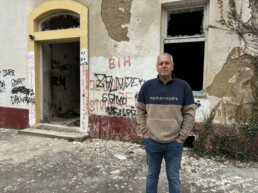
From occupied Crimea to the war-torn cities of Bosnia-Herzegovina, war is not only fought on the ground but also in people’s minds. Propaganda, rumours, denial of crimes: fabricated narratives take hold, blur reality, and reshape lives. In Ukraine, they trap entire populations in fear and isolation; in Bosnia, they prolong the war by denying past violence and preventing any peaceful reconstruction. Through intimate stories, this article explores how disinformation becomes a lasting weapon—capable of surviving conflicts, poisoning memory, and making truth increasingly difficult to assert.
Read their article on  and

FRANCE
Fake News, the Second War of the Refugees
Authors: Marie Boëton and Marianne Meunier
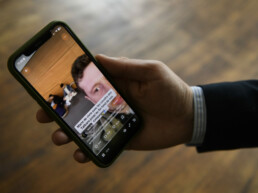
Afghan, Ukrainian, Gazan or Iranian refugees—all fled war to find protection in France, only to become targets of disinformation campaigns directed against them. Manipulated videos, viral rumours, pseudo-reportages or edited clips circulating on social networks become invisible weapons of attack, capable of turning ordinary scenes into public accusations and of durably undermining lives already marked by exile. Through several narratives, the investigation shows how these digital manipulations exploit fears and stereotypes linked to migration, while extending the propaganda logics of conflict. Far from being mere informational errors, these fake news items appear here as a strategic tool of destabilisation, with very concrete consequences for the individuals targeted.
Read their article on  and

Bosnia and Herzegovina
The Forgotten Street
Author: Edvin Kanka Ćudić
In Brčko, a photograph went around the world. It shows the execution of two civilians in the middle of a street, becoming an emblematic piece of evidence of war crimes in Bosnia-Herzegovina. Yet on the ground, nothing recalls what happened. Between the initial use of the images for propaganda purposes, contradictory versions, and institutional silence, the truth itself seems to waver. This article shows how, even in the face of indisputable visual evidence, disinformation can blur facts, delay the recognition of victims, and gradually erase the memory of a crime.
Read his article on and

Bosnia and Herzegovina
From Yugoslavia to Ukraine: militarised childhoods
Authors: Maida Salkanovic and Iryna Synelnyk
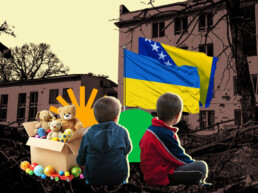
From militaristic stickers collected in the Balkans to TikTok recruitment in Ukraine, war infiltrates childhood through narratives and images. Yesterday as today, disinformation and propaganda shape children’s imaginaries, normalise violence, and redefine the boundaries between play and real engagement. But in the digital age, this influence reaches a new threshold: children are no longer only exposed to biased narratives—they become direct targets, sometimes even instruments of war. This article explores this troubling evolution, where the manipulation of information progressively turns childhood into a battlefield.
Read their article on  ,
 and
Bosnia and Herzegovina
Prijedor, Besieged Truth
Author: Rijad Cerić
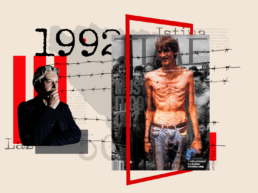
In Prijedor, the war has never truly ended. Thirty years after the camps, massacres, and mass graves, another battle continues: the battle over narrative. Despite images, testimonies, and international verdicts, disinformation continues to deny, distort, and erase the crimes. Behind these lies, survivors are once again made to falter, forced to defend a truth that has already been legally established. This article dives into the heart of this unequal struggle, where the manipulation of information prolongs violence and prevents memory from being rebuilt.
Read his article on and
Bosnia and Herzegovina
In Republika Srpska, fleeing amid rising hate speech and targeted attacks
Author: Vladimir Kovačević
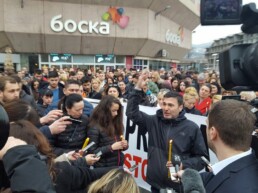
Thirty years after the end of the conflict that tore apart Bosnia-Herzegovina, in one of its entities, Republika Srpska, a different kind of violence is emerging—more insidious. No longer that of weapons, but of words and fabricated narratives. Through disinformation campaigns, journalists, activists, and critical citizens are labelled as enemies, exposed, and gradually pushed out of public space—sometimes into exile. By recounting these trajectories, this article shows how, three decades after the war, the manipulation of information continues to shape reality and fuel a lasting climate of fear.
Read his article on  and
Ukraine
Try Slavery, You’ll End Up Liking It”
Why Priests Remain in the Ukrainian Orthodox Church of the Moscow Patriarchate
Authors: Lioubov Velytchko, Alyona Malitchenko
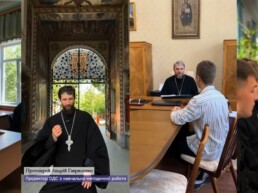
This article examines how pro-Russian disinformation became deeply rooted within the Ukrainian Orthodox Church of the Moscow Patriarchate over several decades. Through the testimonies of Ukrainian priests, it shows how historical and religious narratives — such as the idea of a “triune Rus” or the claim that Ukraine is inseparable from Russia — were spread through seminaries, sermons, and church structures in order to shape minds and preserve Moscow’s influence.
The article also reveals the mechanisms of control and manipulation operating within the Church: hierarchical pressure, financial dependence, fear of reprisals, and moral or spiritual blackmail. After Russia’s full-scale invasion in 2022, several priests began to realize the role this religious propaganda had played in justifying the war. Yet leaving the Moscow Patriarchate remains extremely difficult, as networks of influence and fear of exclusion continue to exert powerful pressure.
Read their article on 

These reports were produced as part of Wars and Lies – The Human Cost of Disinformation project, funded by the International Organisation of La Francophonie (OIF) and implemented by the Mediacentar Foundation (Bosnia and Herzegovina), After War (France) and the Regional Institute for the Development of the Press (Ukraine). The content is the sole responsibility of its author(s) and does not necessarily reflect the views of the OIF or the organisations implementing the project.